

Key Takeaways 1. India’s private credit assets under management grew over 25-fold, from US$0.7 billion in 2010 to US$17.8 billion in 2023, making India one of the leading private credit markets in the Asia-Pacific region. 2. Domestic private credit funds have gained market share over global counterparts, supported by local expertise, deeper market penetration and growing demand for tailored financing from mid-sized businesses. 3. Private credit investments reached US$6 billion across 96 deals in H1 2024, with real estate leading by value and deals valued at US$10–40 million accounting for over half of all deals. 4. Infrastructure spending, flexible financing,
[...]
Continue Reading
Enter your details to view the full report.
- 1. India’s private credit assets under management grew over 25-fold, from US$0.7 billion in 2010 to US$17.8 billion in 2023, making India one of the leading private credit markets in the Asia-Pacific region.
- 2. Domestic private credit funds have gained market share over global counterparts, supported by local expertise, deeper market penetration and growing demand for tailored financing from mid-sized businesses.
- 3. Private credit investments reached US$6 billion across 96 deals in H1 2024, with real estate leading by value and deals valued at US$10–40 million accounting for over half of all deals.
- 4. Infrastructure spending, flexible financing, insolvency reforms, digital infrastructure and tax changes have supported market growth, alongside investors’ increasing interest in alternative investments.
- 5. India’s expanding mid-market financing needs, rising HNI and family-office participation, and growing investor confidence could sustain the private credit industry’s future development.
Private credit provides an alternative source of financing for businesses with unique funding needs and irregular cash flows, cases which banks may avoid due to higher risk and regulatory restrictions. Private credit lending mostly takes place via asset managers involving a private credit/alternative investment (AIF) fund that intermediates between the ultimate lender and borrower. Such loans are generally senior secured, variable rate, and may comprise multiple credit facilities.
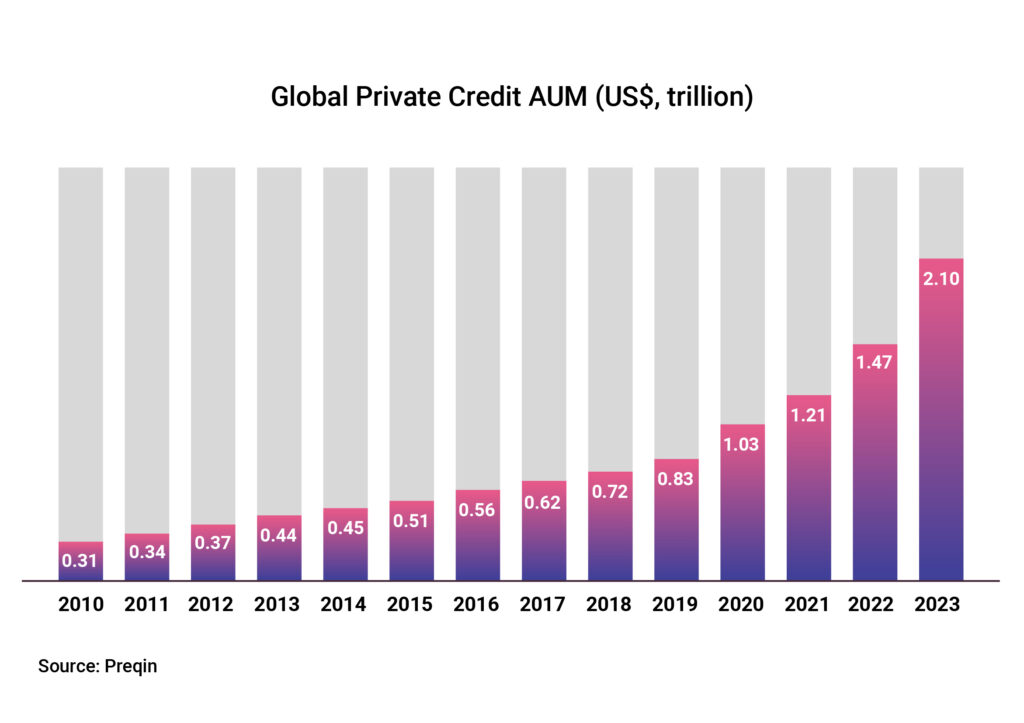
The Private Credit market has been growing at a fast pace across the world, and India is no exception. Globally, the market started gaining pace after the financial crisis in 2008 as banks retreated from riskier lending to small and mid-sized businesses and to companies backed by Private Equity. It witnessed a 5x growth in assets under management (AUM) over the last 10 years to over US$2 trillion in 2023.
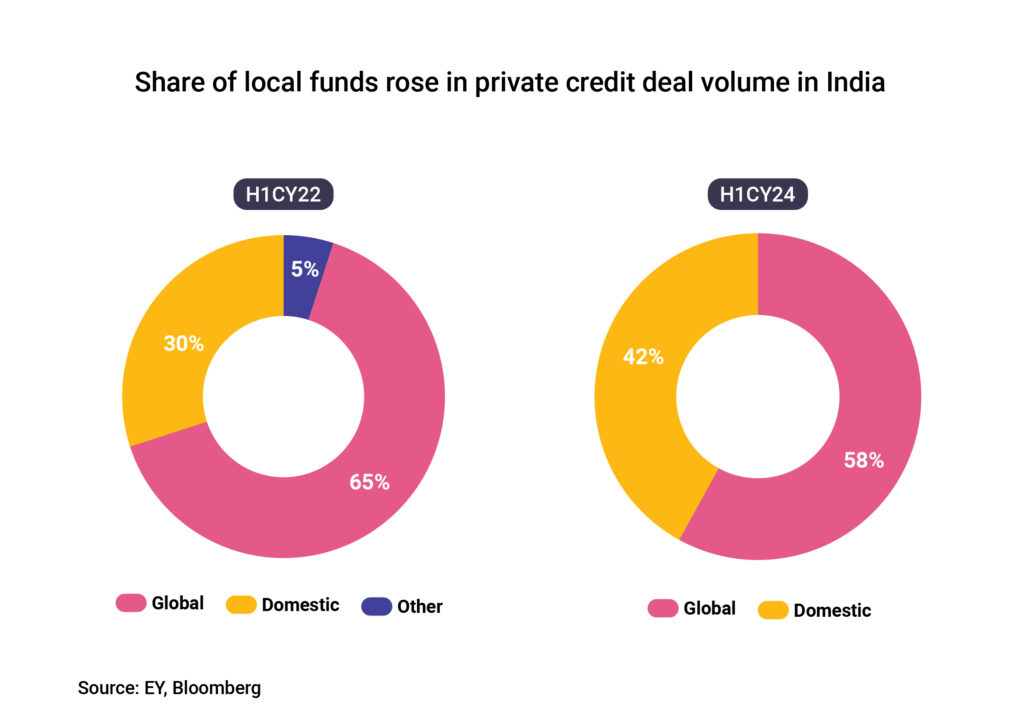
With respect to the market share in the private credit space, there has been a trend reversal in the last few years. Domestic private credit funds started stealing the pie from global counterparts due to several factors such as the local expertise of asset managers and other factors as outlined below helping them to achieve market depth and diversification.
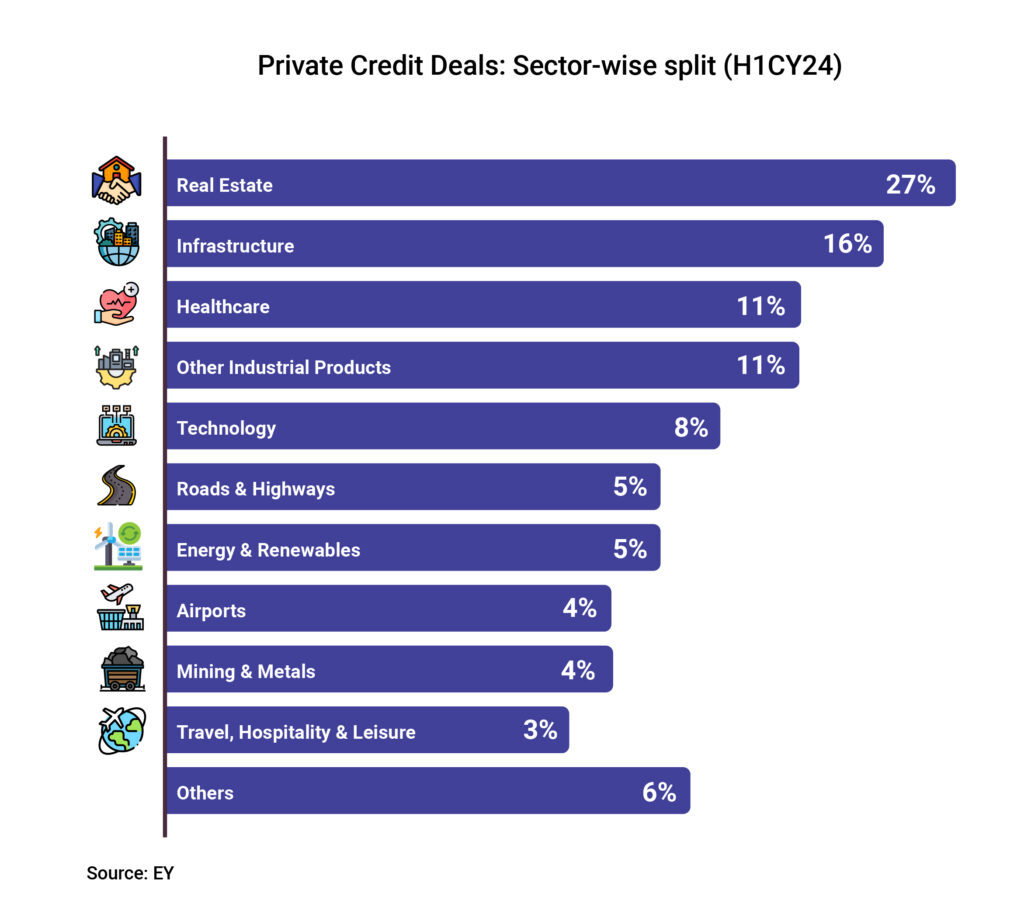
In the first half of 2024, India’s private credit market gained significant momentum as private credit investments surged to an all-time high for any six-month period. Investments totaled US$6 billion which are deployed across 96 deals. Like before, real estate dominated the space, in terms of value, followed by infrastructure, and other sectors.

- Infrastructure spending: Private credit gets an impetus from the government’s push for large infrastructure projects. The Centre has doubled the spending on infrastructure projects over the past three years with the objective of boosting the economy. In the Union Budget, a record INR 11.11 lakh crore has been earmarked for such projects in the financial year ending March 2025 (FY25), which in terms of GDP, stands at 3.4%. As large corporations win more and more infrastructure projects, ancillary work is being awarded to more and more small and mid-sized companies boosting the demand for private credit.
- Flexible financing solutions: The private credit players are able to provide flexible financing solutions to fast-growing mid-sized companies, including favorable loan structures and repayment schedules, compared to traditional bank loans, while catering to borrowers’ specific needs.
- Regulatory climate: The enactment of the Insolvency and Bankruptcy Code (IBC), 2016, acted as a catalyst for the growth of the private credit market in India. It became a statutory instrument to effectively safeguard funds’ interest in debt investments in companies that are moved to IBC proceedings and boosted investors’ confidence. This is because IBS helped in expedite insolvency resolutions and maximize returns for creditors.
- Role of digital infrastructure: India’s digital infrastructure (with the likes of the Account Aggregator framework) has been playing a key role in developing the private credit market by streamlining the underwriting process. It made easier for private credit lenders to access goods and services tax (GST) records, credit histories, and other relevant information.
- Tax reforms: Private credit funds, mainly Debt AIFs, got the much-awaited level-playing field in the taxation of debt investment products as the Finance Act 2023 brought tax parity across all debt products. It leveled the playing field for debt asset managers of various pooled investment vehicles by standardizing taxation.
- Shift in investors’ preference: Higher disposable income and better access to financial information have enabled the young Indian population to make prudent investment decisions, increasingly moving them away from traditional investment avenues to private credit funds/AIFs.
Conclusion
Several Private Credit exits in H1CY24 depicted a vibrant market with significant returns and evolving strategies. Going forward, confidence in the asset class is expected to grow with more and more high-net-worth individuals (HNIs) and family offices backing domestic funds and with a faster pace of growth in the economy.
Frequently Asked Questions (FAQs)
1. What is considered the private credit market?
The private credit market involves financing provided to businesses through non-bank lenders, typically using private credit funds managed by asset managers. These funds act as intermediaries between investors and borrowers, offering financing structures tailored to business requirements. According to the article, private credit loans are generally senior secured, carry variable interest rates and may comprise multiple credit facilities.
2. How big is the private credit market now?
According to figures cited in the October 2024 article, assets under management in India-focused private debt increased from US$0.7 billion in 2010 to US$17.8 billion in 2023. Private credit investments also reached US$6 billion across 96 deals in the first half of 2024. These figures illustrate the market’s growth during the period covered by the article, rather than its current size.
3. Why is private credit booming?
India’s private credit market is expanding due to increasing needs for flexible financing solutions by fast-growing mid-sized companies .he article also identifies govt’s push for infrastructure spending, the Insolvency and Bankruptcy Code, improved digital infrastructure and taxation reforms as important growth catalysts.
Disclaimer:
The views provided in this blog are of the author and do not necessarily reflect the views of Vivriti. This article is intended for general information only and does not constitute any legal or other advice or suggestion. This article does not constitute an offer or an invitation to make an offer for any investment.