

Private credit is lending directly to private, mid-market companies, outside traditional bank loans and public debt markets. Alternative asset managers provide these loans using capital pooled from investors, who earn returns from the interest paid on these loans.
Historically, Indian investors have relied on listed equities for growth, real estate and gold for wealth preservation, and traditional fixed income for stability and income.
Today, private credit is emerging as a distinct portfolio allocation, offering attractive income potential, structured protection against losses, and diversification beyond traditional asset classes.
What is Driving the Shift?
- The search for yield beyond traditional fixed income products.
- Greater awareness and accessibility of private market opportunities.
- A desire for portfolio diversification and attaining high yield with optimal mark-to-market volatility.
Traditional Asset Allocation & Private Credit
In a traditional portfolio, debt preserves capital and provides income while equity drives long-term growth. Private credit can potentially bridge the two, offering income-oriented returns with structured protection against losses.
For instance, an investor’s debt allocation may be concentrated in fixed deposits (FDs) and traditional debt products, which typically offer gross yields of around 5–8%. Direct bond investments may offer higher yields, but investing in individual issuers can increase concentration risk.
Adding an allocation to private credit can help to enhance the return potential of an overall portfolio. It allows investors to seek higher returns within their debt allocation, without having to shift entirely to equity.
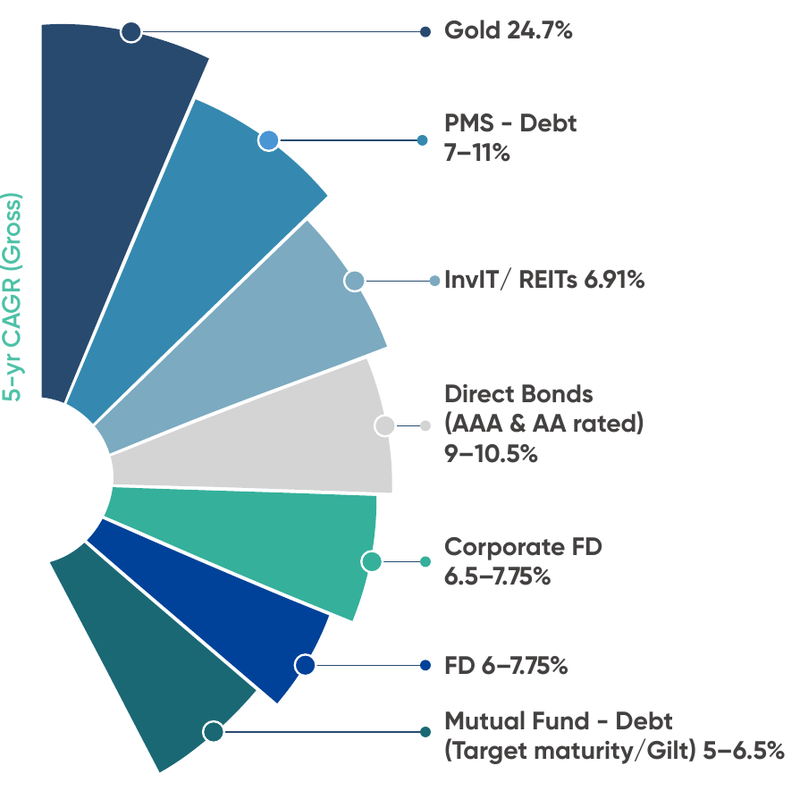
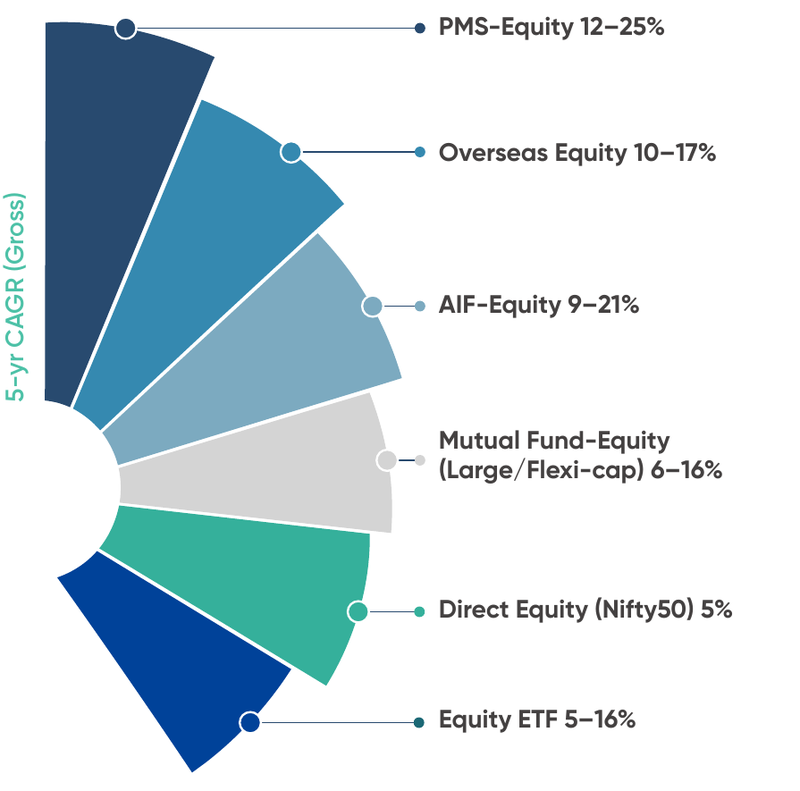
Note: Returns are calculated as of Sep 28, 2026, and indicative, actuals might vary.
View returns as a table
| Asset Allocation-Debt/Hybrid/Commodity | 5-yr CAGR (Gross) |
|---|---|
| FD | 6-7.75% |
| Corporate FD | 6.5-7.75% |
| Direct Bonds (AAA & AA rated) | 9-10.5% |
| Gold | 24.7% |
| Mutual Fund – Debt (Target maturity/Gilt) | 5-6.5% |
| InvIT/REITs | 6.91% |
| PMS – Debt | 7-11% |
| Private Credit (Gross IRR) | 12-22% |
| Asset Allocation-Equity | |
| Direct Equity (Nifty50) | 5% |
| Mutual Fund-Equity (Large/Flexi-cap) | 6-16% |
| Overseas Equity | 10-17% |
| Equity ETF | 5-16% |
| PMS-Equity | 12-25% |
| AIF-Equity | 9-21% |
Sources
Asset Allocation-Debt
- FD Returns – Paizabazaar.com
- Corporate FD – Stablemoney.in
- Direct Bonds (AAA & AA) -wintwealth.com
- Gold – adityabirlacapital.com
- Mutual Fund – Debt (Target maturity/Gilt) – Groww.com
- InvIT/REITs – Nifty REITs & InvITs Total Return Index (as of Jul 31, 2026)
- PMS Debt – PMS Bazaar
Asset Allocation-Equity
- Direct Equity (Nifty 50) – screener.in
- Mutual Fund-Equity (Large/Flexi-cap)- ET Money
- Overseas Equity – Angelone.in
- Equity ETF – Angelone.in
- PMS Equity – Aequitasindia.in
- AIF Equity – pmsaifworld.com
What Private Credit Offers?
 Participation in India’s growth story – A solution to fund India’s credit growth, particularly the under-banked medium-sized enterprises powering India’s economic growth.
 Attractive risk-adjusted returns – Combines disciplined deal structuring, downside protection, and active portfolio monitoring. Privately negotiated deals, predictable cash flows, and security cover help generate attractive returns while managing investment risks.
 Resilient & all-weather portfolio – Low correlation with public markets, helping minimise volatility and deliver resilient performance across market cycles.

As the asset class matures and access improves, private credit is steadily gaining a larger role in investor portfolios. It is increasingly being considered a strategic allocation, particularly by investors looking to build diversified portfolios that can perform across different market cycles.
FAQs
What is private credit, and how does it work?
Private credit is lending directly to private, mid-market companies, outside traditional bank loans and public debt markets. Private credit lending typically takes place via asset managers involving an alternative investment (AIF) fund that intermediates between the ultimate lender and borrower. Such loans are generally senior secured, variable rate, and may comprise multiple credit facilities.
Why is private credit emerging as a separate portfolio allocation in India?
Private credit is emerging as a distinct portfolio allocation due to attractive income potential, structured protection against losses, and diversification beyond traditional asset classes.
How can private credit bridge the gap between debt and equity in a portfolio?
Private credit can potentially bridge the gap between debt and equity in a portfolio, offering income-oriented returns with structured protection against losses.
How does private credit differ from FDs and direct bonds within a debt allocation?
Adding an allocation to private credit may allow investors to seek higher returns compared to FDs within their debt allocation. Direct bond investments may offer higher yields but investing in individual issuers can increase concentration risk unlike private credit, which typically provide diversification across companies and sectors, reducing dependence on any single borrower.
How does private credit manage risk?
Private credit manages risk through a combination of rigorous credit assessment, customised deal structuring, and active portfolio monitoring.
Why does private credit have low correlation with public markets?
Private credit has a lower correlation with public markets because its investment deals are privately negotiated, held outside public exchanges, and valued differently from publicly traded securities.
How does private credit funds support India’s growth?
Private credit funds play an important role in India’s economic growth by providing tailored financial solutions to under-banked mid-market enterprises addressing the financing gap faced by them.
Vivriti Asset Management Private Limited | SEBI Registered Portfolio Manager (Co-investment services only) (Regn. No. INP000009913) & AIF Investment Manager
Disclaimer: The information provided in this article is for general informational purposes only and is not an investment, financial, legal or tax advice. While every effort has been made to ensure the accuracy and reliability of the content, the author or publisher does not guarantee the completeness, accuracy, or timeliness of the information. Readers are advised to verify any information before making decisions based on it. The opinions expressed are solely those of the author and do not necessarily reflect the views or opinions of any organization or entity mentioned.